
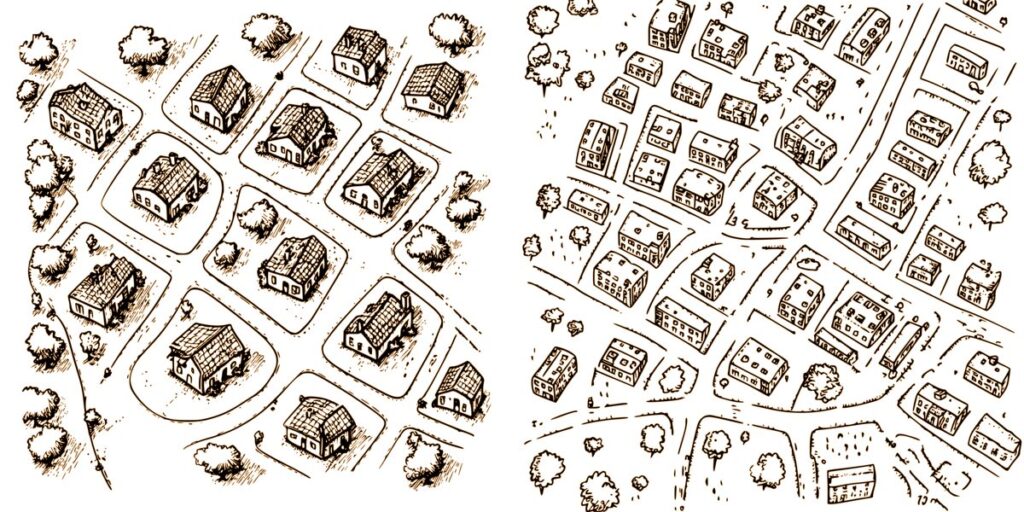
A Neighborhood Between City and Countryside
Wykagyl Crossways occupies a particularly inviting corner of northern New Rochelle. Its streets—among them Berrian Road, Bon Air Avenue, Disbrow Circle, Disbrow Lane, Elizabeth Road, Norman Road, Rose Lane, Rosehill Avenue, Seacord Road, and Siebrecht Place—form a residential landscape that feels peaceful without being isolated. The neighborhood stretches generally from North Avenue west toward Twin Lakes and Nature Study Woods, and from the vicinity of Highland Park north toward Northfield. ([en.wikipedia.org](https://en.wikipedia.org/wiki/List_of_neighborhoods_in_New_Rochelle%2C_New_York?utm_source=openai))
For longtime residents, Wykagyl Crossways is defined as much by its atmosphere as by its boundaries. The roads are quiet, the houses are close enough to create a sense of community, and mature trees soften the view in every season. Tudor, Colonial Revival, and Mediterranean-style homes reflect the period when New Rochelle was rapidly changing from a semi-rural community into one of Westchester’s most desirable suburbs.
The result is a neighborhood with a strong sense of place: part residential park, part historic landscape, and part gateway to the natural spaces of the city’s North End.
Before the Houses: Farms, Woods, and Early New Rochelle
Before sidewalks and carefully landscaped front yards, the land around Wykagyl Crossways consisted largely of farms, woodlots, wetlands, and country lanes. New Rochelle itself was founded by French Huguenots in the late seventeenth century, and the city’s northern reaches remained comparatively rural long after the waterfront and central village had begun to develop. The surrounding land was shaped by both Native American history and later Dutch, English, and Huguenot settlement. ([newrochelleny.gov](https://www.newrochelleny.gov/DocumentCenter/Home/View/123?utm_source=openai))
The area also stood near important early routes leading north through Westchester. North Avenue eventually became the principal spine of the upper city, connecting residential districts with commercial centers and transportation routes. Even today, driving along North Avenue from the Crossways toward Wykagyl’s business district gives a sense of how the old rural road evolved into a major suburban thoroughfare.
Some street names preserve memories of the earlier landscape. Disbrow Circle and Disbrow Lane recall the Disbrow family and the farm property that once occupied part of this section of New Rochelle. That land would later become closely associated with Wykagyl Country Club, one of the defining institutions of the wider neighborhood.
How Wykagyl Got Its Name
The name *Wykagyl* has an unusually colorful history. The Wykagyl Country Club began in 1898 as the Pelham Country Club, when golf was still a relatively new sport in the United States. After the club was forced to leave its original grounds, members moved to the former Livingston Disbrow farm in New Rochelle. The club established its permanent home there in the early twentieth century. ([wykagylcc.org](https://www.wykagylcc.org/Default.aspx?p=DynamicModule&pageid=366791&ssid=278343&vnf=1&utm_source=openai))
With the move came the need for a new name. William K. Gillett, a club member, was credited with selecting “Wykagyl.” One tradition suggests that he created the name using letters from his own name. Another, more romantic explanation connects the word to an older Native American place-name, sometimes interpreted from *wigwos* and *keag* as “birch bark country.” Historians have noted that the precise origin remains debated, but the name was firmly established by the time the club settled along North Avenue. ([mgagolf.org](https://mgagolf.org/history-of-wykagyl-country-club/?utm_source=openai))
The club’s name soon became the name of the surrounding district. When the New York, Westchester and Boston Railway opened through the North End in 1912, its Wykagyl station helped turn what had been an outlying area into a commuter suburb. Developers and investors promoted large tracts of nearby farmland as residential communities, and “Wykagyl” became a recognizable address for both homes and businesses. ([en.wikipedia.org](https://en.wikipedia.org/wiki/List_of_neighborhoods_in_New_Rochelle%2C_New_York?utm_source=openai))
The Rise of the Residential Parks
Wykagyl Crossways emerged during the great suburban building era of the early twentieth century. From the 1910s through the 1930s, New Rochelle experienced tremendous residential growth. Developers laid out planned neighborhoods with curving streets, modest setbacks, and houses designed in the architectural styles popular with middle- and upper-middle-class buyers.
Crossways homes tended to be more moderate in scale than the estate-sized houses found in nearby Wykagyl Park. Many were built in the Tudor, Colonial, and Mediterranean traditions, with brick façades, slate or tile roofs, arched doorways, dormers, and carefully arranged gardens. These houses were intended to offer modern suburban comfort while retaining the character of a country residence.
Bon Air Park is an especially important part of this story. Originally developed around Bon Air Avenue as a single-street residential park, it was later understood as part of the larger Wykagyl Crossways neighborhood. Its compact layout and cohesive collection of homes help explain the appeal of New Rochelle’s early residential parks: neighbors lived close together, but tree-lined streets and individual gardens preserved a feeling of privacy. ([en.wikipedia.org](https://en.wikipedia.org/wiki/List_of_neighborhoods_in_New_Rochelle%2C_New_York?utm_source=openai))
Rose Hill adds another layer to the neighborhood’s heritage. In the years before residential construction, the area was associated with Rose Hill Nurseries and Greenhouses, known for orchids and rare and exotic plants. The nursery’s presence reminds us that gardening and horticulture were once central to the identity of Upper Rochelle. The later houses may have replaced greenhouses and growing fields, but many properties still display the love of planting and landscaping that characterized the earlier era. ([en.wikipedia.org](https://en.wikipedia.org/wiki/List_of_neighborhoods_in_New_Rochelle%2C_New_York?utm_source=openai))
Golf, Railroads, and the Wider Wykagyl Community
Wykagyl Country Club remains one of the area’s most recognizable landmarks. Founded in the age of early American golf, the club’s New Rochelle course was laid out beginning in 1905 and became known for its wooded terrain and demanding hills. Its history is also tied to the formation of the Professional Golfers’ Association of America; a 1916 gathering at the club helped prepare the way for the PGA’s organization. ([wykagylcc.org](https://www.wykagylcc.org/Default.aspx?p=DynamicModule&pageid=366791&ssid=278343&vnf=1&utm_source=openai))
The railroad was equally important to the neighborhood’s growth. The New York, Westchester and Boston Railway offered residents a direct commuting connection, encouraging the construction of homes, apartment buildings, stores, and offices around the Wykagyl station. Although the railway ceased operating in 1937, its influence remains visible in the density and layout of the North Avenue corridor. ([newrochelleny.gov](https://www.newrochelleny.gov/Archive/ViewFile/Item/1732?utm_source=openai))
In practical terms, the railway helped transform Wykagyl from a destination into a community. Families could enjoy a suburban home while commuting to jobs in New York City or other parts of Westchester. The neighborhood’s location between transportation, shopping, schools, and open land made it especially attractive.
Nature at the Neighborhood’s Edge
One of Wykagyl Crossways’ greatest treasures is its relationship with Twin Lakes and Nature Study Woods. Trails, wetlands, wooded slopes, and open areas create a natural counterpoint to the neighborhood’s houses and streets. Together, Twin Lakes Park and Nature Study Woods form one of New Rochelle’s largest connected natural areas, with footpaths and varied habitats along the Hutchinson River. ([en.wikipedia.org](https://en.wikipedia.org/wiki/New_Rochelle%2C_New_York?utm_source=openai))
For residents, these spaces are more than scenic backdrops. They offer places for walking, birdwatching, quiet reflection, and children’s exploration. A short walk from a residential street can lead into woods that feel remarkably removed from the surrounding city. This closeness to nature is one reason the neighborhood has retained its appeal through changing generations.
A Heritage That Continues
Wykagyl Crossways has evolved, but it has not lost its essential character. Houses have been renovated, gardens redesigned, and families replaced by new families. Cars and modern commuting have taken the place of the old railroad, while North Avenue has grown into a busy commercial route. Yet the neighborhood’s original pattern remains recognizable.
Its heritage lives in the names of its streets, the architecture of its homes, the wooded paths near Twin Lakes, and the enduring presence of Wykagyl Country Club. It also lives in the everyday rituals of neighborhood life: evening walks along Bon Air Avenue, children riding bicycles on quiet side streets, autumn leaves gathering along Rosehill Avenue, and neighbors greeting one another at the edge of a park.
That combination of history, architecture, and natural beauty is what makes Wykagyl Crossways special. It is not simply an early suburban development. It is a living chapter of New Rochelle’s story—one where old farms became gardens, country roads became neighborhood streets, and a distinctive name grew into a community with a character all its own.